Agencies & studios
Win projects, deliver them, and bill without the handoffs.
An agency does not lose money on the work. It loses money in the handoffs — the brief retyped into the project tool, the hours reconstructed on a Friday, the invoice assembled by reading back through a chat thread.
Four handoffs, four chances to lose a number.
A studio of six people usually runs the same relay. New business sits in one founder's inbox and a spreadsheet only they update. The project starts in a task tool where somebody retypes the brief from the proposal. Hours are recorded in a second tool by whoever remembers, or not at all. At month end one person rebuilds the invoice from the project tool, the timesheet and their memory of what was agreed in a call in week two.
Every one of those four steps is a copy, and every copy is where a discount gets forgotten, an out-of-scope round gets absorbed, or twelve hours never make it onto a bill. The tools are not the problem — the distance between them is.
Corker's answer is unglamorous: the lead, the quote, the project, the hours and the invoice are all attached to the same client record, so the handoff becomes a conversion rather than a retype.
An agency fortnight, step by step.
This is the path a single piece of work takes through Corker, from the referral to the invoice. Every step below is in the product today.
-
Monday: the enquiry goes on a board, not in an inbox
A referral arrives. It becomes a card on a lead board with a value, an owner, the client organisation and a stage — and your boards can be separate, so new business, partner referrals and renewals are not competing for the same column. Each stage carries a probability, so the board header tells you what the pipeline is worth twice: in full, and weighted.
-
Tuesday: the proposal is a document, not a deck rebuilt from scratch
Convert the lead into a draft quote and the title, the brief, the organisation, the contact and the value come with it. Build the scope out of free-text lines for the paragraphs that explain a phase and priced lines for the phases themselves, nest a discount under one line or under the whole document, and send it as a branded PDF from inside Corker. When they come back asking for the cheaper option, revise it: a new draft, a bumped revision number, and the old one marked revised rather than overwritten.
-
Thursday: winning it does not mean re-typing it
Mark the lead won and convert it into a project. The name, the brief, the category, the contract type, the organisation and the tags carry across; you add the project manager, the dates, the cost centre and the accounting code. The lead stays permanently linked to the project it became, so in eight months you can still read what you actually promised.
-
Friday: the shape of the work
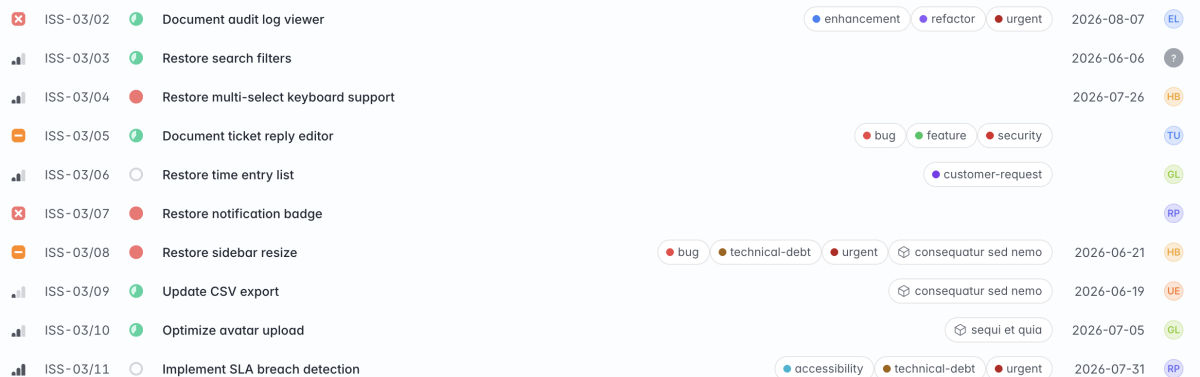
Epics are the phases — discovery, design, build, launch — and issues are the work inside them, each with an owner, a priority, an estimate in hours, a deadline and tags. Every project has both a board and a list. Group the board by assignee when the question is who is buried, by priority when the question is what gets cut.
-
The following Monday: can the four of us actually do this?
The planning board is one row per person and one lane per project, across a window of one to twelve weeks. Drag a bar to move it, drag its edge to resize it, drag across an empty row to create one. Each person's week shows the hours they are planned for against the hours they have — after their working week and your public holidays are taken off — and marks the week on track, tight or over.
-
Month end: the invoice is already half-written
Fixed-price work invoices from the accepted quote, which copies every line across exactly — structure, discounts and tax rates. Time-and-material work invoices from the timesheet: Add unbilled hours lists every uninvoiced billable entry for that client, grouped by activity, and each one you select becomes its own line at the activity's price. Once the invoice leaves draft, the hours behind it lock, so the timesheet and the invoice still agree next quarter.
Each step has a page of its own if you want the detail: pipeline and CRM, projects and delivery, time tracking and quotes and invoicing.
The objection
"So can it tell me whether that project made money?"
No. Not today, and it is the first thing an agency owner asks, so it should be the first thing this page answers.
Corker records an estimate in hours on every issue and totals the hours actually logged on the timesheet, and it knows what each activity is priced at. What it does not do is put those numbers next to each other. There is no project budget, no estimated-against-actual comparison at project level, no margin, no profitability report and no utilisation figure. The dashboard shows overdue invoices and the amount outstanding per currency; it does not show what a campaign cost to deliver.
What you can do is export the time-entry CSV — thirteen columns, carrying the filters you had on screen, including which invoice each hour ended up on — and do the arithmetic in a spreadsheet. That is a real answer to a real question, and it is also a spreadsheet, which is the thing this page opened by complaining about. If automatic per-project margin is the reason you are shopping, be aware you would be buying it on the promise that it is coming, and nobody should buy software that way.
And the second objection: your designers already have tools they like
Corker is not trying to be the place design happens. It has no integrations at all — no public API, no chat app connection, no design-tool link, no cloud-storage sync, no calendar sync. Your team keeps designing where they design and talking where they talk.
The trade is specific: Corker replaces the CRM spreadsheet, the quote template, the project tracker, the timesheet and the invoicing tool with one set of client records, and it asks your team to record time in a typed timesheet rather than a stopwatch. If the five tools you would drop are the five above, the trade is worth making. If they are the ones your designers open every hour, it is not, because those are not the tools Corker replaces.
Check these first
Six things an agency should know before switching.
- Retainers are invoiced by hand. A project can be labelled retainer, but nothing recurs on its own: there are no recurring invoices and no subscription billing, so last month's invoice is duplicated into this month's draft.
- No client-facing approval. A quote is marked accepted or declined by someone in your workspace after the client replies. There is no link the client clicks to sign it off.
- No proofing, no asset review and no file library. Attachments live on issues and on comments; Corker is not where a client marks up a layout.
- No rate card. A price lives on the activity your workspace defined, so senior design and junior design are two activities rather than two rates on two people.
- No import. Live clients, open leads and unfinished projects are typed in or left where they are.
- Creative work that is billed per deliverable rather than per hour gets no special handling: a deliverable is a priced quote line, and its hours are tracked like any other.
Bring your worst handoff.
Corker is in private beta and access is granted in small groups. Tell us where your agency loses a number today — between the proposal and the project, or between the timesheet and the invoice — and that is what we will look at first.
Someone else's version of the same week.
Corker is one product, and these pages describe how differently it is used depending on what you sell. See all five segments on the homepage.
- IT services & MSPs A ticket queue with SLA targets per client and business hours — and a clear account of what Corker is not, if you are looking for an RMM.
- Consultancies Proposal, engagement, hours and invoice in one line — and the truth about utilisation reporting, which Corker does not have.
- Accounting firms One record per client, the advisory work beside the compliance work, and Swedish invoice details that usually need a second system.
- Contractors & small teams Quote today, invoice on Friday, and a short list of what a two-person team gives up by using one tool instead of five.
Ready to bring it all into one place?
Corker is in private beta. Join the waitlist and we will be in touch when your invite is ready.
© 2026 Corker. In private beta.