Consultancies
Pipeline to project to invoice, with the hours that justify it.
A consultancy sells hours and buys salaries, and the gap between the two is decided by two things: whether the right people are busy, and whether the hours they worked reached an invoice.
Two questions, asked every Monday, answered in two systems.
The first is forward: who is free in three weeks, and can we say yes to the thing in the pipeline? The second is backward: of the hours the team worked last month, how many reached a client invoice, and which ones quietly did not?
In most firms of this size the first question is answered in a spreadsheet somebody maintains on Fridays, and the second is answered by a partner reading through a timesheet export the week after the invoice went out. Both answers are late, and one of them costs money every month it is late.
Corker puts both on the same client record. The engagement you are staffing, the hours logged against it and the invoice they end up on are one chain, and every link in it is a screen rather than a hand-off.
One engagement, from first call to issued invoice.
Five phases, each on a screen that already knows what the previous one recorded. Everything described here is in the product today.
-
Before the engagement
A pipeline you can weight
- Opportunities sit on a lead board with a value, an owner, a stage and a probability on each stage, so the board tells you both what is in the pipeline and what it is worth once discounted for reality. Calls, meetings and follow-ups are scheduled against the lead with an optional reminder, and every stage move is written into the lead's timeline with who moved it.
-
The proposal
A document that survives three rounds of scoping
- Convert the lead into a draft quote and the title, description, organisation, contact and value come across. Scope is written as free-text lines between the priced lines, phases are separate lines, and a discount can hang off one line or the whole document. When the client asks for the reduced version, revise it: a fresh draft with a bumped revision number, the old one marked revised, both kept. Quotes expire on their own after the validity period the workspace sets.
-
Staffing it
The only question that matters in month two
- The planning board is one row per consultant, one lane per engagement, across one to twelve weeks. Each person's week shows planned hours against the hours they actually have, once their working week and your public holidays are taken off, and flags the week as tight or over. It is the forward-looking view: who can take the next piece of work, and who is already promised twice over.
-
Delivering it
Hours priced by what was done, not who did it
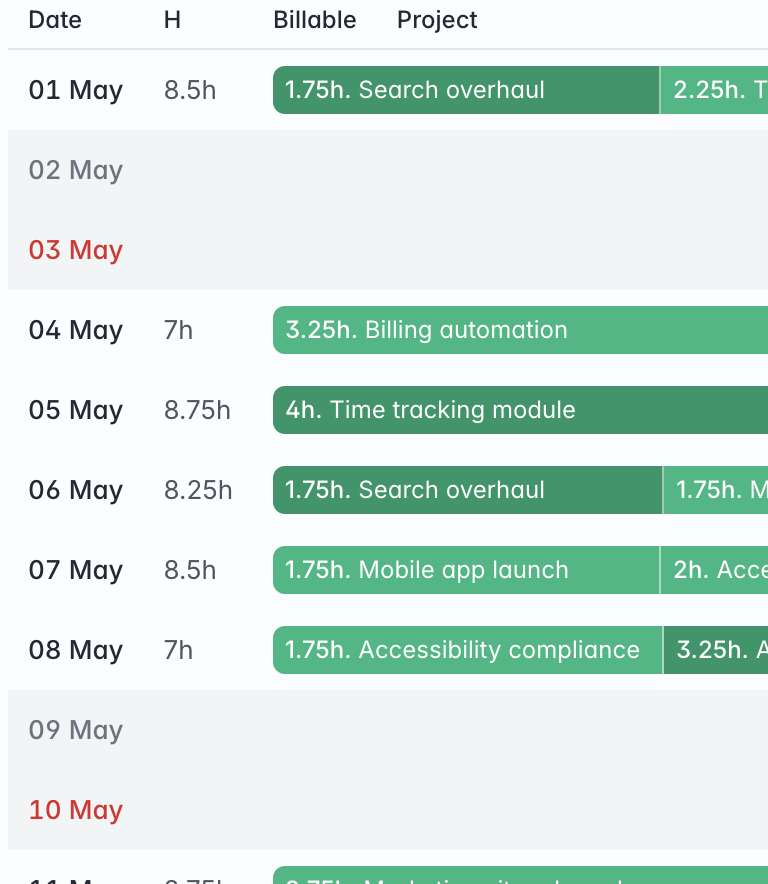
- Time is logged against the engagement and an activity, with a start and an end. Activities are defined once for the workspace — which can be logged against, which are invoiceable, and what each costs per unit — so senior advisory and workshop facilitation are separate activities at separate prices. An hour of an internal activity is simply not billable; nobody has to remember a checkbox.
-
Billing it
The monthly invoice, assembled rather than reconstructed
- On a draft invoice for that client, Add unbilled hours lists every uninvoiced billable entry from everyone on the team, grouped by activity, with a running total as you select. Each entry becomes its own line at the activity's price with its tax rate. Once the invoice is issued those hours lock, so the timesheet and the invoice still agree at the year-end review.
The mechanics of each phase are written up in full on the product pages: pipeline and CRM, projects and delivery, time tracking and quotes and invoicing.
The objection
"We run this firm on utilisation. Does it report that?"
No, and this is the single most likely reason a consultancy should walk away from Corker today, so it gets the plainest paragraph on the page.
There is no utilisation figure anywhere in the product. Nothing divides billable hours by available hours, per person, per month or per practice. There is no realisation rate, because there is no rate per person to compare a price against, and no margin, because nothing holds what an hour costs you. The dashboard shows overdue invoices and the outstanding amount per currency — not a utilisation chart.
What exists instead, and how far it gets you
Two things get most of the way there, and it is worth knowing exactly how far. Forward, the planning board compares each person's planned hours against their available hours for every week in the window, and tells you which weeks are tight and which are over. That is capacity, which is the question you ask before signing, and it is live.
Backward, the timesheet totals a period into billable and non-billable hours, every day carries its own split, and the CSV export gives you thirteen columns — including the person, the client, the activity and which invoice each hour ended up on. A monthly utilisation figure is one pivot table away from that file. That is a real answer, and it is also a manual step every month, which is exactly the kind of thing you would be buying software to remove.
So the test is simple. If your partners need a utilisation dashboard on the wall, Corker is not it today and buying on the promise of one would be a mistake. If what actually leaks in your firm is hours that never reach an invoice, that is the specific leak this product was built to close.
Check these first
Where a consultancy will feel the edges.
- No rate card, and no rate per person, per client or per engagement. The price sits on the activity, which means a two-tier team is modelled as two activities rather than two rates.
- No margin or cost side. Nothing multiplies an hour by what that hour costs you, so realisation and contribution are spreadsheet work.
- No approval or submission workflow on timesheets. Nothing is submitted, nothing is signed off, and a month cannot be locked by hand — issuing the invoice is what freezes the hours.
- No running timer. Every entry is typed with a start and an end, which suits reconstructing a week and does not suit a stopwatch team.
- No forecast beyond twelve weeks, and no scenario planning. The board plans the weeks in front of you, one to twelve at a time.
- No expenses, disbursements or mileage. There is a product catalogue you can add priced lines from, but no expense claim that finds its way onto a client invoice.
- No client-facing document. A quote is marked accepted internally after the client replies, and there is no link for them to sign.
Tell us which number you manage the firm by.
Corker is in private beta and access is granted in small groups. Reporting is the part still being decided, and the firms in the beta are the ones deciding it — so if utilisation is the number on your wall, say so when you join the waitlist.
Someone else's version of the same week.
Corker is one product, and these pages describe how differently it is used depending on what you sell. See all five segments on the homepage.
- Agencies & studios Pitch, deliver and bill a client campaign from the same record, with the week planned against the people you actually have.
- IT services & MSPs A ticket queue with SLA targets per client and business hours — and a clear account of what Corker is not, if you are looking for an RMM.
- Accounting firms One record per client, the advisory work beside the compliance work, and Swedish invoice details that usually need a second system.
- Contractors & small teams Quote today, invoice on Friday, and a short list of what a two-person team gives up by using one tool instead of five.
Ready to bring it all into one place?
Corker is in private beta. Join the waitlist and we will be in touch when your invite is ready.
© 2026 Corker. In private beta.