IT services & MSPs
Every ticket measured against the SLA you actually agreed.
An agreed response time you cannot evidence is a discount you have not noticed yet. Corker measures every ticket against the policy that client actually signed, on the hours you actually work.
Read this before anything else
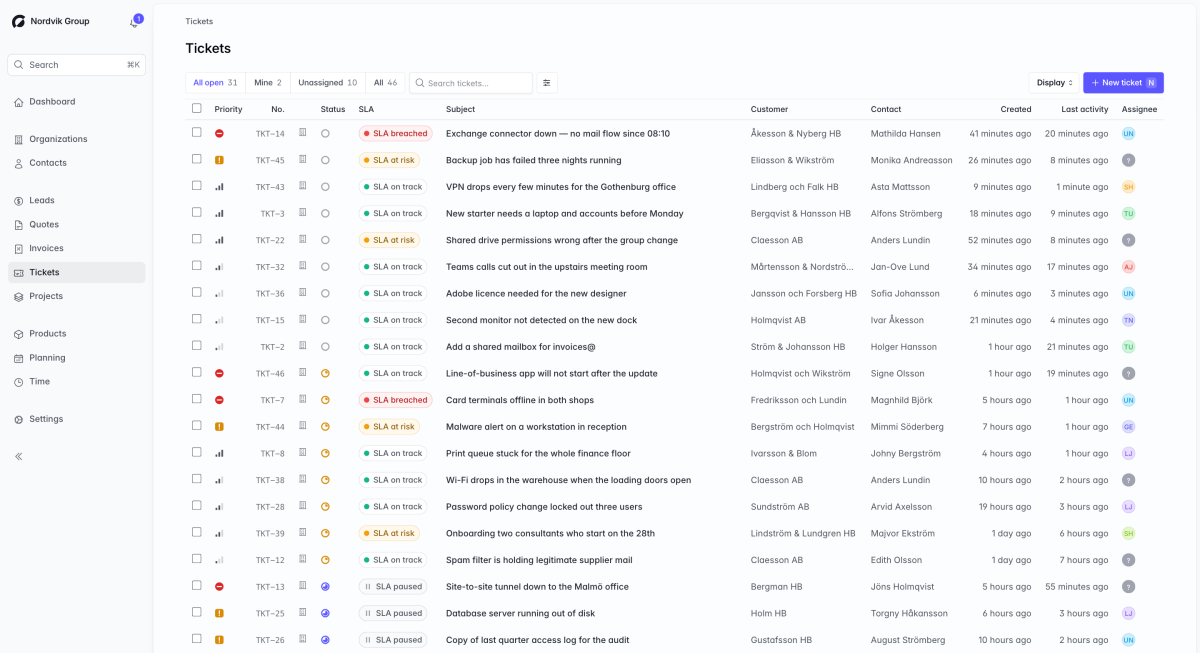
How work reaches the queue today.
Your work arrives by email and by phone. So this page starts where an honest evaluation would start rather than where a sales page would.
Today, in production, a ticket is raised inside Corker by someone on your team — the call gets logged, the forwarded email gets typed in. Replies you send from the ticket are emailed to the requester and everyone CC'd on it, and the thread is kept. Two pieces arrive at launch: email in, ticket out, where forwarding or CCing a support address files a routed, threaded ticket by itself; and a public portal where a client submits a request and follows it. Both are written and tested. Neither is switched on in production, and neither is described here as available until it is.
If your intake is entirely inbound email and you need that automated on day one, the honest answer is to join the waitlist and come back at launch. Everything else on this page is live now. The full support and SLA page has the detail.
What "four hours" means, exactly.
Most tools treat an SLA as a countdown from creation. That is not what you sold: you sold four working hours, on your working days, excluding the time you spent waiting for the client. Here is how Corker measures it — all of this is live in production today.
A policy is one priority, two targets and a working week
A policy sets a first-response target and a resolution target in minutes for a single priority, and optionally a weekly business-hours window: the weekdays you work and the hours you work them. Four priorities means four policies, which is tedious once and exact forever.
The client's policy wins, if it fits the ticket
Attach a policy to an organisation and their tickets at that priority are measured against it. Anything else falls back to the workspace policy for that priority. A ticket that matches no policy simply has no SLA rather than an invented one — which is the right answer for the client who never signed an agreement.
The clock only runs while it is your problem
Time counts while a ticket is new or open, and pauses while it is pending or on hold, banking the working time already spent. Waiting three days for the customer to confirm a maintenance window does not eat your resolution budget, and resuming does not reset it.
Out of hours, the clock stops
The business-hours window is rebuilt for each local day rather than applied as a fixed offset, so the change to and from summer time does not silently remove an hour from a target. Public holidays are not excluded, though — see the list further down.
At risk before breached
A ticket is flagged at risk once less than a fifth of its budget remains, which is the point where somebody can still do something about it. Breach is the fallback, not the alert.
A job that looks every five minutes
A scheduled job sweeps every open ticket every five minutes, records a first-response breach and a resolution breach once each, and notifies the assignee — or every team leader, if nobody owns it yet. Your client should never be the monitoring system.
First response is stamped by the reply, not by a human claiming it
The first public reply to a ticket stamps the first-response time and moves a new ticket to open. Internal notes do not count, because the customer did not receive one.
The ticket is linked to the fix
A ticket links to any number of issues in your projects, so the third report of the same fault and the piece of work that finally resolves it are joined up — and the client record shows their tickets, projects, quotes and invoices on one page.
The objection
"We already have a PSA. Is this one?"
Not in the sense the word usually carries in this industry, and the two gaps are worth being blunt about.
Corker does not monitor anything
There is no device or asset inventory, no agent on an endpoint, no patch management, no remote access, no monitoring and no alerting. There is also no public API and no webhook you can point an RMM at, so an alert from your monitoring stack cannot open a ticket automatically. Corker sits beside your RMM; it does not replace it, and pretending otherwise would waste a demo.
And it does not bill your contracts for you
This is the sharper one. A project can be labelled retainer, but the label changes no behaviour: there are no recurring invoices, no subscription billing, no per-seat or per-endpoint contract billing, and no block of prepaid hours that a ticket draws down. A monthly retainer is invoiced by duplicating last month's invoice into a new draft and sending it.
There is a second consequence for support work specifically. Time is logged against a project and an activity — there is no "log time" button on a ticket, and a ticket carries no hours of its own. Teams that bill support by the hour do it by keeping a support project per client and logging against that, which works, and is genuinely one step further away than it should be.
So: if you are replacing a full PSA with contract billing and an RMM integration, Corker is not that. If your tickets, your project work and your invoicing currently live in three systems that do not know about each other, that is exactly the problem it solves. How time and invoicing connect.
What a managed service provider does get.
Beyond the queue itself: ninety-eight separate permissions and roles you define per workspace, so a first-line engineer can work tickets without being able to see an invoice. Multi-team workspaces with quick switching, if you run more than one brand, with each workspace's data isolated from the others. Two-factor authentication with recognised devices. An activity trail on tickets, issues, projects, epics and leads recording what changed, when and by whom.
And the part that is easy to undersell: the client record. The organisation your ticket belongs to is the same record that holds their contacts, their projects, their quotes and their invoices, so answering "what is going on with this client" is one page rather than three logins. What a client record holds.
Check these first
What the queue does not do.
Corker's support is built for a small team answering their own clients, not for a contact centre or a national service desk.
- No attachments on tickets, in either direction. A screenshot of the error has to be described rather than sent.
- No reporting on SLA attainment. Response and resolution times are recorded on every ticket and breaches are stored, but nothing averages them into the monthly figure a client will ask for.
- Public holidays are not taken out of SLA business hours. The weekly window is the whole calendar an SLA knows about.
- No escalation ladder, no round-robin assignment and no rules engine. Assignment is a person choosing, in bulk if they like.
- No merging two tickets, no ticket categories or types, no tags on tickets, and no satisfaction survey.
- Breach and at-risk alerts are in-app notifications, not emails, SMS or a chat message.
- Canned responses are fixed text with no merge fields, so no automatic greeting by first name.
- One more distinction, because the words collide: Corker gives you SLA features for your clients. Corker itself offers no uptime service level agreement.
Tell us what your agreements actually promise.
Corker is in private beta and access is granted in small groups. The email intake and the client portal switch on at launch, and what they do first is still being decided — which is a better reason to join now than any feature list.
Someone else's version of the same week.
Corker is one product, and these pages describe how differently it is used depending on what you sell. See all five segments on the homepage.
- Agencies & studios Pitch, deliver and bill a client campaign from the same record, with the week planned against the people you actually have.
- Consultancies Proposal, engagement, hours and invoice in one line — and the truth about utilisation reporting, which Corker does not have.
- Accounting firms One record per client, the advisory work beside the compliance work, and Swedish invoice details that usually need a second system.
- Contractors & small teams Quote today, invoice on Friday, and a short list of what a two-person team gives up by using one tool instead of five.
Ready to bring it all into one place?
Corker is in private beta. Join the waitlist and we will be in touch when your invite is ready.
© 2026 Corker. In private beta.